|
Agile Teams
|
AHEAD:
the
Attribute
Hierarchy-based
Evaluation
of
Architectural
Designs
Method and papers
|
|
Karen Smiley,
Qingfeng He,
Elizabeth Kielczewski,
and
Aldo Dagnino
|
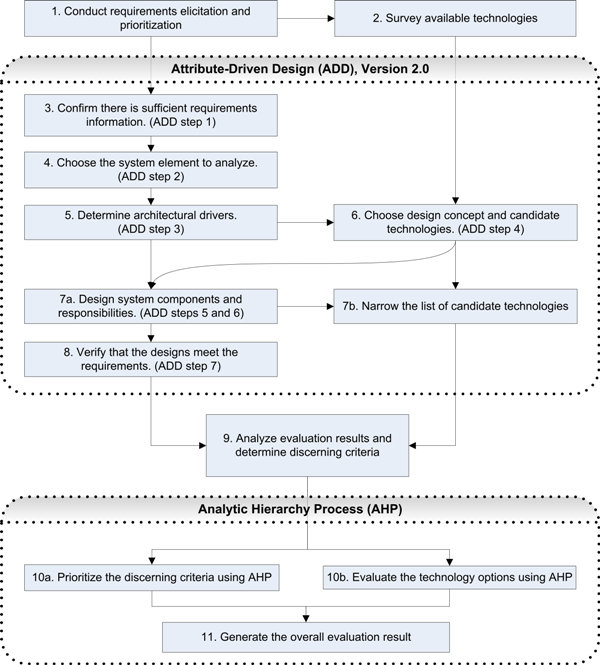
(updated version of the diagram coming soon!)
|
AHEAD is designed to complement and extend the Software Engineering Institute's
Attribute-Driven Design (ADD) method for First Fit and Best Fit
software technology evaluations. AHEAD includes guidance on requirements elicitation,
surveying available technologies, analyzing and clearly defining evaluation criteria,
and using the increased objectivity and quantification of the
Analytic Hierarchy Process (AHP) to strengthen the final judgments and selection.
The AHEAD method was created by the authors to support
software systems development teams in
quantitatively analyzing a set of technology options based upon
how well they satisfy important architectural criteria.
The greater the business impact of the technology decision,
the more beneficial the AHEAD method can be.
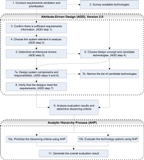
Click the thumbnail image at left to see a
high-level diagram showing the basic steps of the AHEAD method,
see the following papers for further information, or contact the authors at
AHEAD (at) agileteams.com.
|
- Oct. 24, 2008: Paper and presentation at Quality Function Deployment Symposium, Santa Fe, NM, USA
- Feb. 17-19, 2009: Paper and presentation at IASTED Software Engineering Conference, Innsbruck, Austria
- Mar. 8-12, 2009: Short paper and poster at Symposium on Applied Computing, Honolulu, Hawaii, USA.
- Mar. 23-26, 2009: Presentation at SEPG North America Conference, San Jose, CA, USA.
- May 5-7, 2009: Presentation at SATURN Software Architecture Conference, Pittsburgh, PA, USA
- May 18, 2010: Half-day tutorial at SATURN Software Architecture Conference, Minneapolis, MN, USA
|
-
Oct. 24, 2008:
20th North American Symposium on Quality Function Deployment,
Santa Fe, NM, USA. Proceedings ISBN: 1-889477-20-6
"Getting AHEAD: Applying AHP for Software Technology Evaluations"
Authors: Karen Smiley, Elizabeth Kielczewski, Qingfeng He
(presented by Karen)
Abstract:
Evaluations of software technologies and components can be complicated,
and are easily influenced by acknowledged or latent technology biases. The Analytic
Hierarchy Process (AHP) is a natural choice for neutralizing these biases, and bringing
greater objectivity to the evaluations. This paper reports on an industrial project for
software technology evaluation which complemented the Software Engineering Institute's
(SEI) Attribute-Driven Design (ADD) technique by applying AHP for importance ratings
and for comparing the prototype implementations. We present our Attribute Hierarchy-based
Evaluation of Architectural Designs (AHEAD) method, our findings, and our analysis of the evaluation.
-
February 17-19, 2009:
IASTED SE 2009 Conference, Innsbruck, Austria
"Attribute Hierarchy-based Evaluation of Architectural Designs (AHEAD)"
Authors: Karen Smiley, Qingfeng He, Elizabeth Kielczewski, Aldo Dagnino
(presented by Elizabeth)
Abstract:
Technology evaluations can present significant challenges in software engineering practice.
In this paper, we describe an industrial case study, in which we formulated and applied the
Attribute Hierarchy-based Evaluation of Architectural Designs (AHEAD) method for selecting
a software technology to form the basis for the next-generation architecture of a large
commercial product. AHEAD leverages the Software Engineering Institute’s Attribute-Driven
Design (ADD) method and the Analytic Hierarchy Process (AHP) for evaluating software
technologies that have important architectural impact. It provides high-level guidance
for software practitioners to elicit and prioritize architectural requirements, develop
prototypes implementing prioritized requirements, and quantitatively evaluate the technology
options based on prototype results. We found that using the AHEAD method brought greater
objectivity to the prioritization of the architectural requirements and to the technical
judgments of the software technology options.
-
March 8-12, 2009:
SAC 2009 Conference -
Requirements Engineering track, in Honolulu, Hawaii, USA.
"Architectural Requirements Prioritization and Analysis Applied To Software Technology Evaluation"
Authors (poster/short paper): Karen Smiley, Qingfeng He, Elizabeth Kielczewski, Aldo Dagnino
(poster presented by Qingfeng)
Abstract:
In this short paper, we summarize an industrial project in which we developed and applied
the Attribute Hierarchy-based Evaluation of Architectural Designs (AHEAD) method for selecting a
software technology to form the basis for the next-generation architecture of a complex commercial
software application. AHEAD leverages the Software Engineering Institute’s Attribute-Driven Design (ADD)
method and the Analytic Hierarchy Process (AHP) for evaluating software technologies that have important
architectural impact. The core activities of AHEAD include elicitation, prioritization, and analysis of
architectural requirements. The goal of these requirements activities was to establish and apply
objective criteria for selecting, prototyping, and evaluating software technology alternatives.
We found that using AHEAD brought greater objectivity to prioritization of architectural requirements
and to the technical judgments of the software technology options.
-
March 23-26, 2009:
SEPG North America 2009 Conference in San Jose, California, USA.
"Getting AHEAD With DAR: How to Make Better Software Technology Selection Decisions"
Authors: Karen Smiley, Qingfeng He, Elizabeth Kielczewski
(presented by Aldo for Karen)
Abstract:
Software technology and component evaluations can be complicated,
often involving extensive criteria lists and competing stakeholder goals and priorities.
AHEAD is a rigorous multi-criteria decision method which leverages SEI’s Attribute-Driven Design (ADD)
technique and the Analytic Hierarchy Process (AHP). This session summarizes the AHEAD process,
maps it to the specific practices of the Decision Analysis and Resolution (DAR) process area of CMMI,
and describes how we applied AHEAD in an industrial case study.
-
May 5-7, 2009:
SATURN 2009 Conference in Pittsburgh, PA, USA.
"Leveraging ADD for Objective Technology Evaluation and Decision Analysis"
Authors: Elizabeth Kielczewski, Qingfeng He, Karen Smiley
(presented by Karen)
Abstract:
Technology evaluations can present significant challenges in software engineering practice.
Defining the requirements and understanding them in their technical and organizational context
is the starting point. Conducting an objective evaluation against these requirements is another
challenge. In this presentation, we describe how we addressed these issues in an industrial
project involving evaluation of software technologies. We believe software technologies,
such as those considered in this project, must be assessed within the context of the
corresponding architectures. This project was focused on evaluating technologies for
re-architecting the client applications of a well-established software product.
However, the clients’ interactions with other parts of the system, and other systems
within the product family, required an even broader architectural context to be considered.
In this project, we successfully leveraged and extended the Software Engineering Institute’s
Attribute-Driven Design (ADD) method to guide us in analyzing architecturally significant
requirements, architectural design, and prototyping for the evaluation.
- May 18, 2010:
SATURN 2010 Conference in Minneapolis, MN, USA.
"Efficient Software Technology Evaluations Leveraging ADD"
(half-day tutorial)
Authors: Karen Smiley, Elizabeth Kielczewski
(presented by Karen and Aldo)
Abstract:
Some technology selections are easy: few choices,
low impact of ‘wrong’ selections, a handful of
decision factors, one stakeholder – deciders may just
flip a coin.
However, real-life software system technology
evaluations can have many architecturally significant
criteria, multiple alternatives, conflicting stakeholder
priorities, biased (perhaps unknowingly) evaluators,
and severe business consequences of poor
selections.
In this tutorial, participants learn via hands-on
exercises to effectively apply the ADD-based AHEAD
technology evaluation method on technology
decisions that matter.
|
|